BESTIARY OF THE ISLE
Compiled by Sewell Hayden
* * * * *
Livestock and Game
Klantars
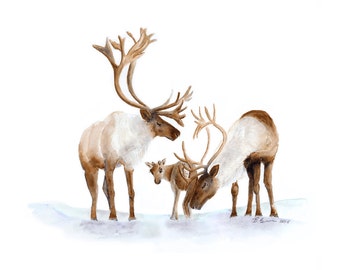
Klantars, also called caribou or reindeer, were brought to the isle during the rein of the first queen during AR5 after more traditional game fared poorly to the change in climate. Gathered from the Great Glacier, this variety weighed upwards from 600 stone and were about six hands from the ground to the start of their antlers, when upright. They sport arching black antlers, thick coats, long snouts, and wide hooves, and are often brownish gray or white-furred in color. Once settled here, their herds preferred the low mountain ranges and plains outside of town, and tended to lichen and shrubs for their primary diet. They were always migratory in nature, and this was never fully bred out from them.
Having good stamina and a good sense of smell, you often need a herding animal or train several to respond to a signal in order to bring them in for milking, and must needs pick off the elderly ones for culling; this allows the younger generation to prosper, and produce healthier young. Their milk is light, and their meat is sweet, needing very little seasoning. The hides of these animals are also useful for cloaks, rugs, and bedding.
Dreels
Dreels were first found in the mountain ranges to the east, after the events of the Rend. Once dwelling deep in the heart of mountain rivers, they somehow made their way to more surface water sources near the Misty Stair waterfalls and Skull Gorge. The additional food sources such as algae, and carrion helped their population boom, and they became invasive for other fish in the area. Brought here around AR12, proper cultivation keeps them well fed and from harming the arctic trout downriver, which propagate in the great lake.
In spite of their mucus-like taste, dreels are quite nourishing. Their taste improves considerably if served properly; remove the gal-sack without puncturing it, as this will turn the meat sour. It also benefits from being fried or pickled with herbs and spices. Offal can be chummed and either used in the fishing of arctic trout, or as a pungent fertilizer.

Gray Rabbit
Small furry creatures hunted as food or as fur for clothing, and prized for its softness. Their fur is most often grey, but turns a spotted tawny color during the spring. They live in burrows called warrens along the western slopes, and during the day they graze on grasses and other small ground plants. Often trapped and sold as food or pets, they are also hunted by carnivores (the few we entertain on the isles), which feed on them at dusk. Their horns, although magic-less, are often collected as trinkets by children.
* * * * *
Creatures of the Forest
Ki-rins
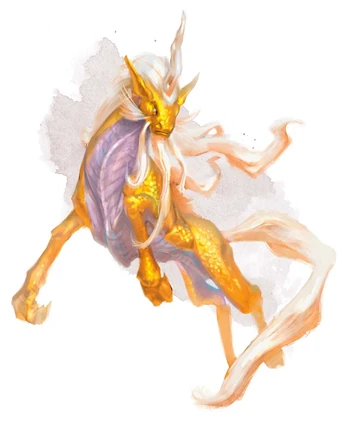
Noble creatures similar to a unicorn in some respects. An equine creature with a single horn, it has a stag-like body but is covered in golden scales instead of fur. Its horn and hooves are pinkish in color, and it has a thick golden mane of hair. Its eyes are often deep violet.
First spotted in AR2 after the ascension of the isle, they were thought to have made it here from the celestial planes before the final sealing of the gate. Unable to return to their home, they became protectors of the forest and advisors to the queen. Only three have ever been known to travel in the forest, and since that time they've been seen less and less.They are regarded as harbingers of good fortune, and days when a ki-rin is sighted are considered blessed.
Ki-rins have been observed to fly without wings, and they had several other powerful innate magical abilities, including the ability to read the minds of those around them. They prefer to avoid contact with humans. If cornered, it has been said they render their opponents unconscious and leave in peace.
Asperii
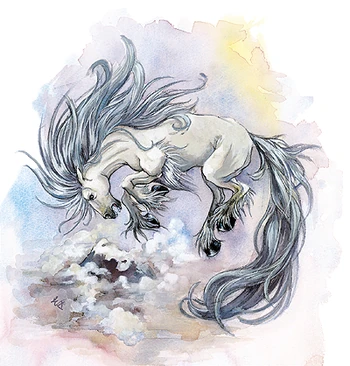
Also known as Wind Steeds, they have the appearance of a normal horse, with a high resilience to cold, and average around eight hands tall. First noticed around AR10 among the normal herds, which were brought during the making of New Dolor, they are often gray or speckled, with long white manes of silver. The strongest and rarest of them have a somewhat iridescent hide. Farmhands claimed to hear voices speaking with them telepathically, warning them of danger or changes in the weather, until one day a small group of Asperii were noticed on the horizon beyond the forest, flying behind a Ki-rin. Wingless, their flight seems based on a natural levitation, combined with an ability to "ride" winds.
Asperii are most assuredly sentient creatures, I dare say even more intelligent than most humans. Via their telepathy, they provide great insight on the surrounding world outside of our home, with some variation of the ancient art of "true sight". They seem to get along well with other equine creatures most, but many young, referred to as doffs, are amenable to training by humans. Once a rider was accepted, an asperii became devotedly loyal to them, never accepting another unless asked to by their first.
They have also been recorded as very territorial, and have chased away wild hippogriffs and griffons from roosting in the nearby mountains of the isle. If forced to defend themselves, they did so quickly and efficiently. With sharp teeth and powerful front legs for kicking, they would attack the faces and wings of their opponents. Asperii are most definitely omnivores with a varied diet favoring fish, hawk flesh, mint leaves, and mistletoe, above other foods. However in times of famine, they have been seen sustaining for long periods without eating anything at all.
Winter Wolves
Originally considered a villainous beast that would hunt both livestock and farmhands, and more akin to a worg than an actual wolf, they were avoided or hunted by all upon the isle during the first years of New Dolor. However, in AR2 they were sought out by the first queen who went into the deep woods; after three days time she returned, a pact having been made with the creatures promising safety and food for all who inhabited the isle. The pact was made with Ragorith One-Eye, the greatest of the pack leaders. Even upon his death of old age in AR42, this pact has been upheld by his kin to this day.
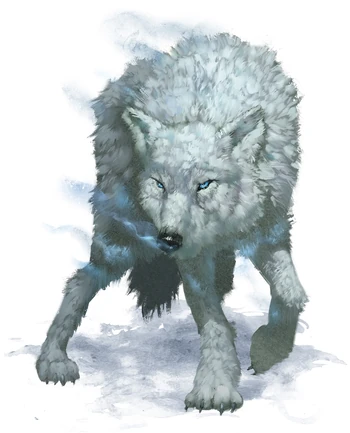
Growing about 8 hands in length and 4.5 hands at the shoulder, they weigh approx. 450 stone. With bright blue eyes and white gray fur, they stalk through the icy forested mountains for wild klantars or the highland planes for gray rabbit. They will lay in wait for prey, and when an ambush is triggered, winter wolves are known to encircle their prey and take turns to attack, or attempt to pin it. They have also been recorded breathing out gusts of frigid cold, and their teeth and claws can cause frostbite. They often live in packs of around three to five, but solitary winter wolves have been known to become friendly with lumberers or stonemasons on the edge of town, trading their skills for a safe refuge and easy food.
* * * * *
Creatures of the Mountain
Galeb duhr
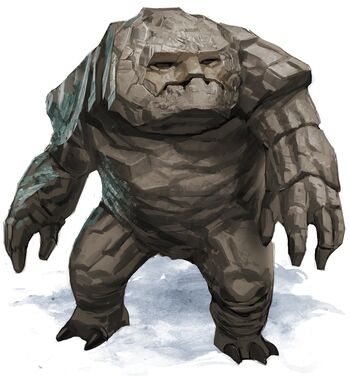
With the appearance of boulders, it is hard to spot one of these reclusive creatures. Magical stone constructs, they were brought here at some unknown time by the first queen during the preparation of New Dolor, approx. AR1, from quartz and granite deposits on the Elemental Plane of Earth. They are known to speak Terran and occasionally, Dwarven.
When they open their eyes or move, one can see they have dark, foreboding eyes, a wide mouth, and two appendages that act as both hands and feet. They range in size from four hands in height to as large as sixteen. Very slow-moving creatures with a steady gait, they are found in the deepest mines and natural tunnels of the isle, with clusters near the magi-mechanical rooms in the center. Their power to control the rocks around them is of great use in keeping the isle in one piece, as it remains forever airborne.
They are slow to think and slow to act, but are very dexterous and intelligent creatures. Similar to how treants were known to have innate power over trees in Old Terra, so galeb duhr have control over the stone around them. They can magically move earth, shape stone, create openings in stone, and even turn rocks into mud. Simply by their will alone could they make these animations occur, to the betterment of New Dolor and to their tightly knit family-like groups.Originally on their own plane they were often solitary creatures, however due to the space limitations of New Dolor, their ecology has changed to be more interpersonal. Despite this, they have little social structure at all--no leaders, no hierarchies, nor anything of the sort.
They have not been known to sleep, nor breathe, and even eating has been recorded as non-existent. They seem to absorb or share nutrients from their rocky environment, and draw sustenance from the earth itself. Based on records from early AR of specific galeb duhr (with markings painted with mud on their exterior as some type of tribe-like ritual amongst them) it can be seen that they have en extremely long lifespan, even thousands of years. Certain galeb duhr still walk today that were around during the first queen's reign, and share stories of those times.
Two other interesting traits of galeb duhr are the collection of gems, mined from veins of precious metal and ores, and music. Their music is hard for most humans to hear due to the low tones, but the subsonic melodies could be felt through the ground for many miles. They will sit in small groups harmonizing with their gravelly voices; the music is resonant and often viscerally sad. Some sages believed that there is a magic in their songs that helps strengthen their mountain homes.
Cave Fisher
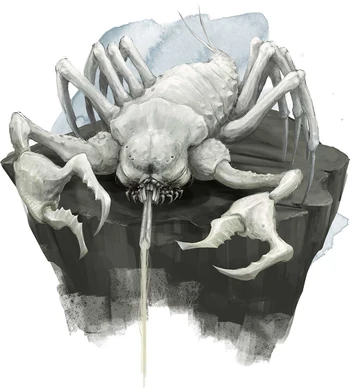
Found in the depths of the mountains, subterranean cave fishers are lobster-like creatures known for ambushing its prey using a sticky filament similar to a strand of spider silk. They grow to about seven hands long and have a hard, chitinous shell arranged in overlapping plates for an exoskeleton. It has eight legs and two forelimbs that end in large pincers. Living underground, cave fishers are sightless creatures that use multiple auditory sensor organs to detect prey. These organs are located on the head and could be mistaken for multiple eyes. The creature has a large proboscis from which it can shoot a sticky filament great distances.
The cave fisher hides on ledges above passageways and hunts by emitting a long strand of sticky filament, either dangling it to catch passing creatures such as bats or rodents, or shooting it at a creature as it wanders by. They can also secrete their adhesive onto their feet and anchor themselves to a ledge, wall, or ceiling once they found a good hunting spot. To release themselves, they secret a substance from their proboscis that contains their blood that dissolves the adhesive.
Cave fishers will attack any creature, even up to man-sized, but is intelligent enough to avoid large groups, preferring to pick off scouts, loners, and stragglers. Normally cave fishers work alone in an area within a mile of its lair, but sometimes they can be found in small groups of less than five, and these pods are known to coordinate ambushes. This cooperation usually ends when there is food to be fought over. Extra food, alive or dead, is wrapped in filament and stuck to a surface in their lair for later consumption.
Cave fishers have flammable blood and are therefore hunted as a fuel for lanterns by workers in the caves, or for people on the surface. The blood can also be used for concocting strong spirits. The meat is edible as well, and tastes similar to crab sauteed in stout wine. Extruded cave fisher filaments can be harvested and treated to dilute the adhesive, and then woven into ropes that are incredibly strong for being so thin; they are nearly invisible. The diluted adhesive could even be applied to gloves and boots to improve their grip when climbing. Lastly, the chitinous shell is very tough and could be used to make armor, tools, and even jewelry.
Cave fisher eggs that are a tenday old or less are highly valued for their alcoholic content, and even psychedelic properties. A sip from one of these eggs can cause an average human to become quickly intoxicated for hours while experiencing hallucinations. Consuming the full contents of one of these potent eggs has been known to be fatal.
Behir
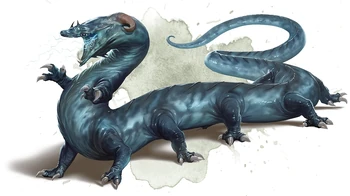
Only one behir has been known to lurk in the deep mountains of the isle, and was likely an unintended passenger during the creation of New Dolor. Records have described it as a wingless blue dragon, sporting a long, snake-like body that could slither on the ground like a snake, but it also had six pairs of legs upon which it could walk or climb. Each of its twelve feet contained three clawed toes, and it was masterfully quick, easily outrunning a typical human.It had thick, armored scales, much like a dragon, colored in variations of dark blue with lighter hues on its underside. Its head was long and narrow, crocodilian in shape, with small, curved black horns on the top and rows of many sharp teeth.
During all recorded sightings of the behir, (the last of which was 200 years ago), it was said to be approximately 25 hands long. It could speak common, and often threatened those who came near its territory. During the last sighting, it had apparently gone to the surface and hunted down a large winter wolf to feast on, and was dragging it back through the tunnels. Multiple attempts to capture it were unsuccessful as prior to that, anyone who came close enough to it was knocked back by powerful bolts of electricity. It is assumed that the magi-mechanical workings in the mountain helped provide a safe, comforting home for it.
* * * * *
Other Types of Beasts
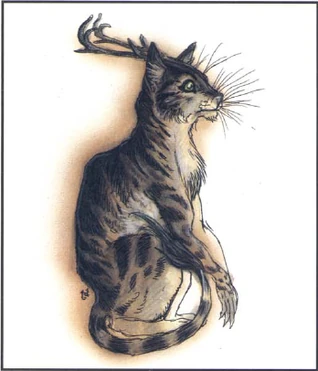
Feystag
A mythical creature of the northern wilds, the feystag is a creature akin to a cat, but with majestic antlers (and a taste not unlike venison). The feystag wields strange power over magical items, causing them to activate to its own desires rather than its masters'. If confronted with an opponent without magic, the feystag resorts to employing its claws, which tear through light armor or clothes like razors. It can also wield weapons, though awkwardly, in its raccoon-like hands.
Feystags are also immune to charms, and are very knowledgeable about magic items; sages first discovered them surrounding the Temple of the Great One, trying to activate any magical devices within. They made friends with the feystags, and used their knowledge to help identify new anomalies and magical items.
Orglash
Also known as an ice spirit, these are rare elemental natives to the prime material plane, brought here in AR80 to help maintain the icy structures beneath the isle and produce the cloudy mist that hides New Dolor from below. Their original homes were being destroyed by invasive tribes, and they were willing to relocate for a safe home.
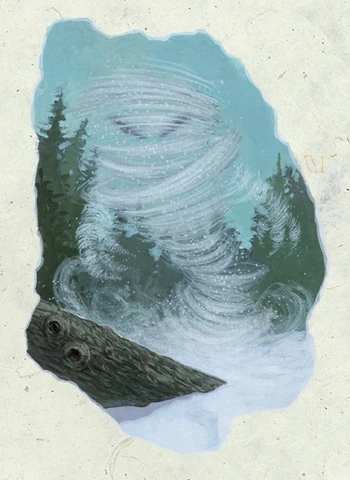
They have insubstantial bodies made of wind and snow. A tiny pair of black eyes can sometimes be seen within their swirling forms. They are wild and chaotic, but are stanch protectors of the land. If needed, some orglash can take the form of a powerful whirlwind, much like an air elemental. They are solitary creatures, and several are spaced out throughout all corners of the isle to prevent any confrontation over territory. During rare times of interaction with humans, they only speak their native language of Auran.